
 Français
Sights
David Epstein
 @david_epstein
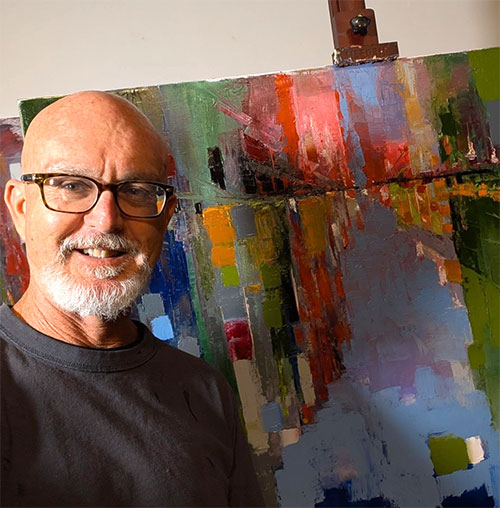
I was born in Tallinn, Estonia, during the Soviet Union era. I was fascinated with art from a very young age and able to copy almost any photo or picture presented to me. My biggest and happiest gift was always a big sheet of white paper, which was not very easy to get during the communist regime.
Later on, I discovered colors, collages, glue, watercolors and pastels. I only started to paint oils in my teens, first on the walls of my bedroom then on canvases. My first attempts in realistic paintings were copying famous artists such as Salvador Dali and Caravaggio. While copying masters was a very good technical exercise, it was not what I really wanted to do. I wanted the paintings to be mine – something that expressed myself my feelings and my colors.
After going through many different styles – from realism to cubism to portraits and landscapes – I have finally arrived at a point where I let my subconscious create the works.
My paintings are large and intuitive – an exploration of colors and moods. My process always involves listening to music while painting and being in a state of mediation and complete surrender to the moods inside of me. Mostly I paint in the winter, and when the outside is grey and the days are cold I create my own realities of warm hues of reds and orange and green.
“A good painting mostly paints itself.”
The emergence of social media has opened my eyes to the astounding quantity of amazing artist all around the world. And, subconsciously, the endless bombardment of visuals recharges the creative batteries of my soul. There are also many works today that are created by AI. At this point it is easy to distinguish between works created by AI and humans. A good work by an artist has soul – something that speaks to the viewer in ways that are beyond the visual. AI will not replace love, and it will not replace true art.
Studio 77 is a hub for all sorts of creative individuals: musicians, writers, visual artists, and more. People come to exchange ideas, and to discuss art and music. I am lucky that I have an opportunity to run my own business and indulge in creativity – a place where I can both paint and exhibit, as well as promote and encourage other artists in the community. I hope to continue to attract the creative people.
Steven Soldano
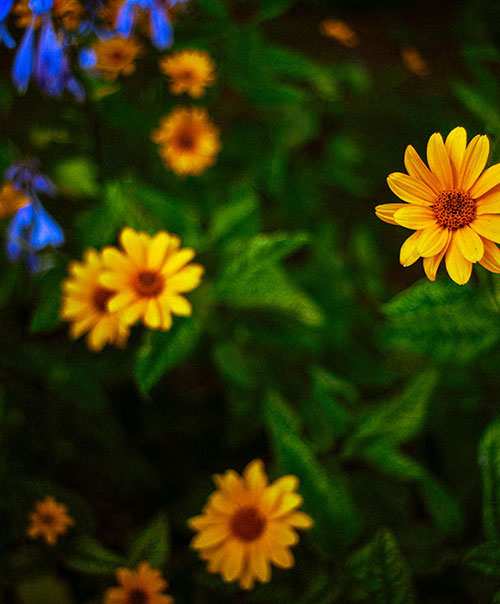 I never thought I would get into photography. I started writing stories when I was 15 because I wanted to make my own movies. I joined a filmmaking group while in university and started experimenting with different lenses and learning the technical side of things a lot more. Photography was an excellent companion. When I wanted to try a new lens or camera setting, I would ask my friends if I could test my gear with them. I didn’t realize how much I would fall in love with the results and how much fun I would have learning.
Taking photos and playing with cameras is fun – no agenda, no higher artistic goal – even taking bad photos nobody will ever see. There are times to concentrate and be technical and make sure the result does what it needs to do, but if you really love taking photos then you should also learn to take the time to do this as a hobby without putting any pressure on yourself.
Having a hobby or passion that you can either choose to enjoy in solitude or involve other people is priceless. The best part, for me, is just being able to make something I am proud of and potentially discover a creative part of myself that I didn’t know was there.
The biggest challenge is balancing passion with a steady paycheque. Most photographers probably get into this because they fell in love with it, and we are told to do what we love and find a way to get paid for it. Sounds simple enough…
I like to take photos that feel nostalgic, either by using vintage glass, shooting film, or editing in a way that emulates film. Taking candids at an opportune moment when I get unfiltered expressions is one of the things I like to shoot the most. Being a fly on the wall when people least expect it can yield surprising results.
A good photograph should tell a story, and that story should be told with intention. The imagination should start to wonder, like you are looking at a single still image from a longer movie. It should spark intrigue or mystery or reveal something.
I only got back into photography recently after a small hiatus, so I don’t have a strict agenda for the immediate future, but my goal is to finally make the ideas I have had in my head for awhile. I want to get out of my comfort zone with my future projects.
@stevensoldano
Maggie Romanovici
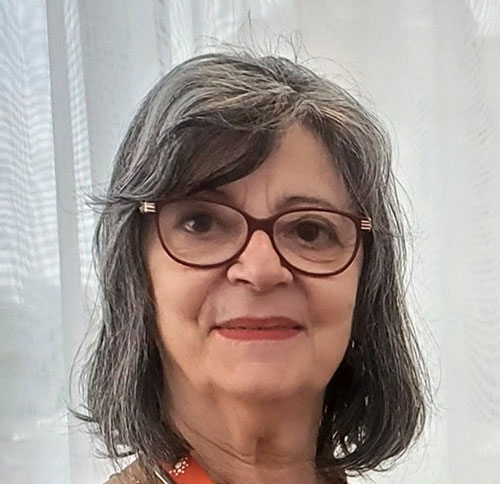 I was born in communist Romania, and I am sure I inherited my father’s talent for drawing. Even in primary school, my teacher noticed my inclination toward art and insisted that I begin a formal art education. I followed her advice – and I loved it. Although I eventually studied languages and became a teacher, I never abandoned art. In fact, I sometimes feel that art never abandoned me. It grew alongside me and became an essential part of who I am.
There are two particularly important moments in my artistic life. I see them as the two legs of an imaginary bridge stretching over the ocean: my first participation in an exhibition in Romania, when I was only twelve years old, and my first solo exhibition in a Montreal gallery. Between these two moments lies an entire life of artistic exploration, change, perseverance, and discovery.
I began as a figurative painter, working mainly in oil and watercolour, and for many years I never imagined that I would change direction. Then, at a certain point, I felt an irresistible need to go further—to move toward greater freedom and a more personal form of expression. That is when I turned to abstraction. The transition was not easy. It took time to discipline both my hand and my mind, and to learn to let imagination and intuition take the lead. I have always found abstraction more challenging because there is nowhere to hide behind a recognizable subject. Every colour, gesture, line, space, and silence must carry its own meaning. Today, I consider myself a lyrical expressionist painter, and I find the creative process much more intuitive and inspirational. I do not approach a canvas simply because I feel that I should paint. I need to be connected to something I am feeling. The emotional state from which a painting begins is very important to me. I let the work evolve through a dialogue between intention, intuition, gesture, colour, and the unexpected. Sometimes the painting takes me somewhere I had not anticipated.
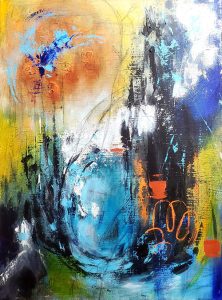 For me, a good painting is one that makes me happy when I finish it – and continues to give me something afterwards. Of course, I hope that viewers will experience something of that same emotion. I do not expect them to see exactly what I see. I would rather leave them enough space to bring their own memories, feelings, and interpretations to the work.
Making a living and raising a family as an artist is not easy. But what art gives you as a person is priceless. It offers a way of seeing the world, of understanding yourself, and of expressing emotions that sometimes cannot be put into words.
I am currently working in my studio on a new collection, and I cannot wait to share it with the public. I am preparing for a solo exhibition at Gallery L’Onyx in mid-November this year. It is always exciting – and a little frightening – to finally let a new body of work leave the intimacy of the studio and begin its own life in the eyes of others.
maggieromanovici.art
@maggieromanovici