 Français
 Marcello Giorgi
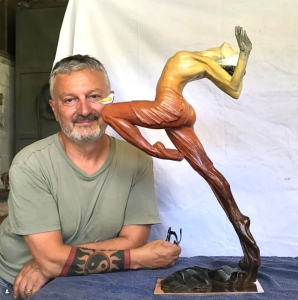
Born in 1962 in Pietrasanta, Italy, Marcello Giorgi was immersed in art and craftsmanship from an early age. Relocating to Montreal in 2016, he began teaching to share Italian sculptural traditions with professional artists and dedicated students. He now leads his sculpture school in Pietrasanta, where he continues to pass on a method rooted in anatomy, form, and the classical tradition. His works are held in museums, public spaces, and private collections worldwide. Recently, Arts Ouest spoke with the West Island sculptor about the nature of art and creativity.
What are your personal roots?
I was born and raised in Pietrasanta, Italy, a town with a long and extraordinary tradition of sculpture. Growing up in this environment had a profound influence on me. Art was not something distant or abstract; it was part of everyday life. I studied at the Stagio Stagi Art Institute and later spent ten years apprenticing at Claudio Mariani’s foundry. Over the years, I had the privilege of working alongside some remarkable sculptors and craftsmen, learning not only the techniques of sculpture but also the discipline, patience, and respect for materials that this profession requires. My roots are deeply Italian, shaped by the artistic heritage of Pietrasanta. But my years in Canada, where I lived and taught sculpture in the Montreal area, also became an important part of who I am, both as an artist and as a person.
When and why did you first get into sculpture?
My journey into sculpture began when I was young, growing up in Pietrasanta, surrounded by workshops, foundries, marble, and artists from all over the world. I was fascinated by the idea that a human figure could emerge from a material that, at first, seemed to have no life of its own. I wanted to understand how an artist could transform a block of material or a mass of clay into something that could communicate emotion, character, and humanity. That curiosity led me to study sculpture and eventually to begin my apprenticeship. What started as a fascination gradually became a vocation and a way of life.
Are they the same reasons you remain involved?
In many ways, yes, although my understanding of sculpture has deepened over the years. I am still fascinated by the process of bringing a form to life, but today I am equally interested in what lies beyond the physical appearance of a figure. For me, a sculpture should express something about the human condition, the personality of a person, or an emotion that words cannot always communicate. Teaching has also added a new dimension to my relationship with sculpture. Sharing my experience and helping other people discover their own artistic abilities has become an important part of my work. Through sculpture, I continue to learn, to question, and to discover new possibilities.
What are the challenges and rewards of the vocation?
I believe these two questions are inseparable. To speak about the challenges of being an artist, I must also speak about the rewards, because my vocation has always been a source of both suffering and happiness. For me, art is a form of torment and ecstasy. It is a love that gives you extraordinary moments of fulfilment but also demands sacrifices and can become an all-consuming passion. People approach art in many different ways. For some, it is a pleasure, a profession, a form of personal expression, or even a way of understanding themselves. All these approaches have their place. But when art becomes a true vocation, something deeper happens. When you fall in love with art, everything changes. The world around you becomes an endless source of observation and study. You begin to see things differently. Colours take on new meanings, emotions become more intense, and you find yourself experiencing the world through your own particular sensibility. Art and creativity are not governed by reason alone; they also emerge from the irrational, from instinct, and sometimes from what we might even call madness. Many years ago, a great master of contemporary art told me something I have never forgotten: “Be careful, young man, because if you fall in love with art, you will never be able to love anyone else in quite the same way. Art will always come first. Art takes your life.” I did not listen to him. I fell hopelessly in love with art, and I have never regretted it. For me, one of the greatest rewards is the moment when a form begins to come alive under my hands. After hours, days, or even months of work, seeing a sculpture gradually acquire its own presence is an extraordinary experience. But sculpture is not simply about reproducing the human body. It is about giving form to something deeper: a personality, an emotion, or an aspect of the human condition that goes beyond physical appearance. Today, teaching has added another dimension to this passion. Seeing a student develop their understanding of the human figure, gain confidence, and discover their own artistic voice gives me a different kind of satisfaction. It allows me to pass on what I have learned over many years and to see that knowledge continue through someone else’s work. Like anyone who is deeply in love, I accept both the happy days and the days of suffering as part of the journey. Perhaps this is the real answer to both questions: the challenges and the rewards are two sides of the same vocation. The same passion that makes this life demanding is also what makes it worth living.
How have you evolved as an artist over time?
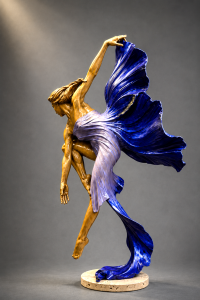
My passion has always been connected to the human body and to the pursuit of three fundamental qualities: beauty, elegance, and harmony. Technique gives you the foundations you cannot do without. But learning never stops. Every day brings a new discovery, another piece of knowledge that allows you to continue along a path that has no end. However, technique alone cannot lead to artistic growth. You also need an open mind and a genuine curiosity about the world around you. Research has always been fundamental to my work. There is an entire world of expressive possibilities to explore, not only through sculptural techniques but also through materials, their different qualities and potential, the use of colour, and all the subtle nuances that a curious artist discovers and eventually makes their own. Over time, I would say that my work has become increasingly sophisticated in its exploration of these possibilities. My curiosity has led me to search for new solutions and to develop an approach that has become progressively more contemporary. Throughout my career, I have been fortunate to collaborate with many contemporary artists and to share ideas and different perspectives on sculpture and art in general. Pietrasanta, the town where I was born and raised, is a meeting point for artists from all over the world. Different cultures, ideas, and artistic visions come together here and influence one another. This is always an enriching experience, provided you remain open to listening and learning from others. Now, at this stage of my life as a sculptor, I have discovered a new kind of fulfilment in sharing my experience with others. I have opened my own sculpture school in Pietrasanta, and it fills my heart with joy when curious students who are passionate about art come through my door. I believe that artistic evolution never really ends. It is a lifelong journey of learning, discovery, and sharing.
How would you describe your style today?
I would describe myself as a contemporary sculptor whose work is deeply rooted in the study of the human figure and in the knowledge of classical sculpture. The human body has always been at the centre of my artistic interests. I am fascinated by beauty, elegance, and harmony, but for me, the figure is also a means of exploring ideas, emotions, and different ways of expressing the human experience. My classical training has given me the technical foundations to pursue this research, but I have never considered tradition a limit. On the contrary, I see it as a starting point from which to explore new possibilities. I am interested in experimenting with materials, textures, colour, and different approaches to form, always looking for new ways to express my ideas through sculpture. Years of collaboration with artists from different cultural backgrounds have also influenced my perspective, encouraging me to remain curious and open to different artistic languages. Ultimately, I do not feel the need to choose between tradition and contemporaneity. I draw on the knowledge of the past to develop my own artistic language in the present. For me, sculpture is a continuous process of research, discovery, and transformation.
What have been some career highlights to date?
It is difficult for me to identify one particular moment or achievement as the highlight of my career. My artistic life has been a continuous evolution, shaped by countless experiences rather than by a single defining event. Over the years, I have created many important works, completed public and private commissions, participated in exhibitions around the world, and taken part in artistic performances. Each experience has contributed to my development, but I cannot say that one particular work or event has defined my journey more than the others. What matters most to me is the life that each sculpture has acquired beyond my studio. I hope my work has brought emotion into people’s lives, encouraged them to reflect, and perhaps even helped them see something differently. For me, a sculpture is never just an object. Every work I have created is a part of my life, connected to journeys, personal experiences, friendships, moments of joy, and sometimes disappointments. Each one carries memories of the people I have met, the places I have been, and the experiences that have shaped me. Together, these works tell the story of who I am today. I have a deep affection for every sculpture I have brought into the world. In a way, they are like my children, and I could never say that one child is more important than another.
Is your creative process more “inspirational” or “perspirational”?
I believe every work of art requires both. Inspiration alone is not enough to bring a sculpture to life, just as hard work alone does not guarantee a satisfying result. Every sculpture begins with an initial idea, but that idea evolves through the process of working. Sometimes the material itself suggests new solutions. Sometimes things come together on a particularly good day; other times, they do not. You can never completely predict how the process will unfold. What I know is that creating a sculpture involves a continuous dialogue between the artist and the material, between the artist and their emotions, and between the artist and their life experience. The work develops through this exchange, often taking directions that could not have been anticipated at the beginning. For me, creating art is not simply a matter of rational thinking or calculation. It involves knowledge and experience, of course, but also intuition, uncertainty, emotion, and discovery. I often think that a work of art is both everything and nothing of who you are. It is everything because it carries your experiences, your emotions, your knowledge, and everything that has shaped your life. And yet, when the work is finished, you may look at it and not fully recognise yourself in it. You may discover something you did not know was within you, a different side of yourself that emerges through the creative process. Perhaps this is one of the most extraordinary things about art: while you are creating a work, you are also discovering who you are. And sometimes, when you finish, you realise that you have changed.
What inspires you?
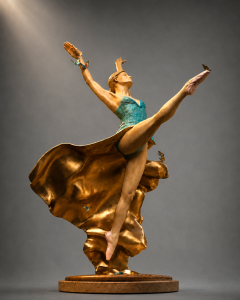
I think what inspires me most is beauty. I find it everywhere, in the world around me, and I am constantly searching for it. I have always been drawn to elegance and harmony, and I often use the human body as a way of expressing these qualities. Sometimes I want to tell a story through a sculpture. Sometimes I want to explore an aspect of nature. And sometimes a particular form simply attracts me, and I feel the desire to give it shape without needing to tell a specific story. Not everything needs an explanation. Sometimes a form is beautiful simply because of what it is. Inspiration can also come from music. I remember something a great master once told me about an orchestra conductor. He asked me to imagine a conductor holding a paintbrush instead of a baton, with a canvas in front of him. As he conducted the orchestra, his gestures would paint his emotions in the air, leaving them imprinted on the canvas. By the end of the performance, he said, the painting would be a masterpiece. Then he explained that the same principle could be applied to sculpture. What matters is not simply the technique or the subject itself, but the love you feel for what you want to represent. I have never forgotten that lesson. For me, inspiration can come from almost anything, provided I am able to recognise the beauty in it. Ultimately, I believe that what inspires me is the desire to express that beauty and share it with others.
What makes a good sculpture?
For me, a good sculpture is the result of several elements coming together. It is not necessarily a question of style or technique. A sculpture can be technically accomplished and still have very little to say. I believe a good sculpture must express something of the artist who created it. It should reflect their vision, their sensibility, and their way of looking at the world. Of course, craftsmanship and professionalism matter, but they are not enough on their own. Above all, a sculpture should make people stop and look. It should invite them to think, question, feel something, or even criticize what they see. The reaction does not necessarily have to be positive. What matters is that the work creates a response and establishes a meaningful connection with the viewer. For me, a sculpture must be more than an object, no matter how beautiful it may be. An artist is not simply someone who produces beautiful things; an artist is someone who creates emotions. I believe there is no greater failure for an artist than to create a work that people walk past without seeing. If a sculpture fails to engage the viewer, to provoke a thought or awaken an emotion, it risks becoming just another object. And for me, there is nothing worse than that.
What are your thoughts on the current state of the arts on the West Island?
Through my personal experience, I have come to know many artists from the West Island, most of them painters. What has impressed me most is the passion that brings this artistic community together, along with the spirit of sharing and the respect its members show for one another’s work. There are different artistic approaches and ways of thinking within the community, and I find that they coexist and complement one another very well. There is a genuine desire to exchange ideas, share techniques, and learn from each other’s experiences. Artists even organise regular gatherings where, in turn, they present their techniques and share the knowledge they have acquired throughout their careers.Being part of this community reminds me of Pietrasanta in earlier years, when artists would come together in a similar spirit of exchange and mutual learning. I find this kind of environment extremely valuable because it allows artists to grow not only through their individual practice but also through their relationships with others. Another aspect that has truly impressed me is the high level of professionalism. I have taken part in several group exhibitions, and I have always been struck by the professionalism and dedication of the artists involved. For me, a community like this demonstrates how much can be gained when artists are willing to share their knowledge, respect different perspectives, and support one another’s work.
What advice might you have for younger creatives looking to have a career in sculpture?
Just as a music student who wants to become a composer or an orchestra conductor cannot expect to perform a concert after only a few lessons, a young sculptor cannot expect great results without years of hard work and study. A composer must learn to understand the instruments and their full potential. In the same way, a sculptor must master different techniques, materials, and tools to find the best way to express an idea. My advice is simple: don’t be in a hurry. Remain a student throughout your life, always curious and open to learning. Visit museums, study the great masters, and draw from life. Learn to observe. And above all, allow yourself to dream of creating your own masterpiece. If the work you are making today is not that masterpiece, all the better. Perhaps it will be the next one, or the one after that. It doesn’t matter. What matters is keeping that desire alive.
 How has the internet, and specifically AI, had an impact on what you do?
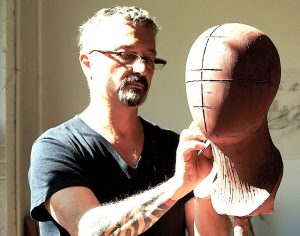
I believe the impact of artificial intelligence on our work is revolutionary. It is changing the way we approach sculpture and the creative process itself. I see AI as a tool, and like any new tool, we need to learn how to use it properly to make the most of its potential. Of course, every tool can also be misused, but I believe that, with time, we will learn how to manage these risks. For artists of my generation, who grew up in a world where the internet did not yet exist, the transformation we are experiencing is enormous. But I believe we have to accept it. The future cannot be denied or rejected. If you refuse to move forward with it, you risk being overwhelmed by it. I remember my master, who, at the age of 85, bought himself a computer and began using it in some of his creative work. One day, I asked him why. His answer was very simple: “We have to keep up with the times.” I have never forgotten those words. They taught me that curiosity and the willingness to learn should never have an age limit.
What’s next on your creative agenda?
At the moment, I am working on an important project commissioned by Arts and Immigration Alliance, a non-profit organisation based in Montreal. They have asked me to create a maquette for a monumental sculpture dedicated to the theme of immigration, a subject that is very close to my heart. I immediately felt drawn to this project because immigration is not just a social or political issue; it is deeply connected to the human experience. Alongside this project, I continue to work on my other commissions. But I am also dedicating a great deal of my time and energy to teaching at my new sculpture school in Pietrasanta, which I recently opened. In many ways, this project allows me to bring a circle in my artistic life to completion. I believe that life can be divided into three great stages. The first is the age of learning, when we acquire the knowledge and skills that will shape who we become. The second is the age when we put what we have learned into practice and build the foundations of our future. Finally, there is the age of giving back. As we grow older, we begin to understand that knowledge alone is not enough. It is experience, accumulated over a lifetime, that gives knowledge its deeper meaning. This is the time to share what we have learned, guide younger generations, and pass on not only our skills, but also the wisdom that life has given us. For me, as a sculptor and a teacher, this third stage has a special meaning. I feel that what I have learned through sculpture, through my work, and through life itself becomes truly valuable when I can pass it on to others. Perhaps this is what I am looking for in this new chapter of my life: to continue creating, to continue learning, and to share what I have learned with the next generation. In this way, something of us continues to live on, long after our own work is finished.








