
 Français

Rob Lutes
Rob Lutes remembers discovering the joy of music as a youngster.
“My mother’s family are from Ontario, and they were very musical,” shares the 50-something songsmith over the phone from his home in Pointe Claire. “She played the piano and there were always these pleasant melodies floating around the house. I was the youngest of six kids, but the only one to pick up a musical instrument. I took piano and ukulele lessons as a child, but everything changed after I found a guitar tucked away in my sister’s closet. Making sound come out of it brought me no end of happiness.”
Although Lutes’ siblings didn’t share the same penchant for playing, they were instrumental in informing his early musical tastes.
“They were all older than me by a few years and had all these records – 45s mostly. When they went off to school I’d run downstairs and put them on our little stereo and just sit there captivated by the Beatles, the Stones, Dylan, Neil Young, Sinatra, and even country music. My love for songwriting, for the craft of songwriting, came out of those experiences.”
Unbeknownst to him at the time, Lutes would eventually carve a career out of that craft himself.
“I have written, recorded and released eight of my own albums and three with another project. I have been on the road a lot as well; Canada, the U.S., and I have toured Europe about 15 times. I still tour here and there, but I have three kids now, so my priorities have changed and I’m happy to be home.”
Domesticity hasn’t seemed to slow Lutes down however; along with regular performances, he instructs students on music history and Tin Pan Alley at the Thomas Moore Institute near Atwater and conducts a Summer Songwriting Series at Cedar Park United Church in Pointe Claire.
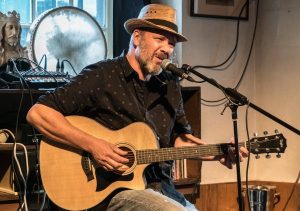
He is also currently teaching songwriting at Concordia University in downtown Montreal.
“I have 60 students and it has been very inspiring. They are in that zone when everything is still fresh, and some of them don’t have the ‘guardrails’ in place yet. They aren’t censoring themselves or adhering to some pre-existing musical formula. And for me, as a songwriter, it’s good to get out of my comfort zone and hear music with fresh ears.”
He often talks with his students about the use of technology in modern music making.
“I’ve done workshops where people have put lyrics into an AI program to create a song and they have been revealing; what comes out sounds smooth and professional, but it clearly lacks heart. Think of Wabi-Sabi, the Japanese concept of finding beauty in life’s imperfections – AI can’t get something like that quite right. That is because being imperfect it a distinctly human experience. Songs breathe and come to life in those little mistakes, in those moments.”
A good song, he says, should be simple.
“Personally, I like it when a tune sticks to one topic; maybe it’s a love song, or a breakup song, or a song about losing your dog, or whatever – something specific that connects with listeners easily. As artists, we are graciously given a certain amount of real estate in a listener’s brain, and we are asking them to devote their neurons to what we are doing, so we should always be respectful of that. And a good song should be able to stand on its own with just a lone voice and guitar or piano, stripped of all production. The architecture of the song, the engineering behind it, must be sound. In the end, though, it is a matter of opinion; what is beautiful to me might not be beautiful to someone else…”
One thing that all musicians and music fans can agree upon is that the music industry has changed greatly over the past quarter century.
“The business model that I came of age with – record labels, management companies and touring agencies funding and supporting artists and bands in the studio and on stage – is gone for good. Nowadays, a musician must be a jack-of-all-trades; artist, accountant, label, manager, agent, promoter, publicist. It’s a full-time job to run the show.”
Despite those challenges, Lutes believes that the rewards make it all worthwhile.
“I have a friend who runs a design company in London, and we were discussing creative work one day. He said to me, ‘we’re not doing this to make money – we’re doing this to make beautiful things.’ And that hit home. Ultimately, writing, recording and performing music has to bring you no end of happiness or it simply isn’t worth doing.”
roblutes.com
@lutesrob








