 Français
Lisa Kimberly Glickman
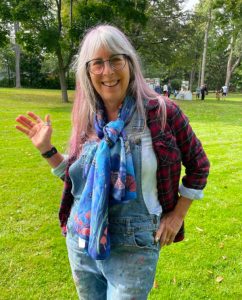
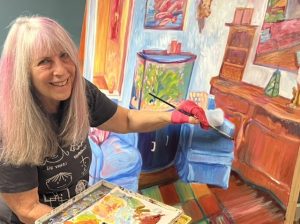 Lisa Kimberly Glickman is a Montreal-based artist whose practice integrates material inquiry, environmental ethics, and representational strategies grounded in the natural world. She holds a BFA from the Rhode Island School of Design and graduate degrees in education from McGill University, with a focus on arts-based learning. Exhibiting publicly since 1984, her work is held in private collections across Canada, the United States, Europe, and Australia. Glickman combines painting, craft, and upcycled materials to create symbol-rich works that engage ecology and labour. Her awards include a Hammer and Sky Residency (2025), the King Charles III Coronation Medal (2024). Recently we spoke with her about her creative vocation.
When and why did you first get into the visual arts?
Art has always been one of my favourite things to do. My mother kept drawings I made when I was just three or four years old, carefully labelling them with my descriptions of what I had created. I think she recognized my early creative spark and, importantly, encouraged and valued it. There’s even a photograph of me at about four or five, proudly holding up one of my artworks. Looking back, I suppose art has always been part of who I am. I’ve never really questioned why I make art; it’s simply something I’m compelled to do. It’s a natural and essential part of my life.
Are they the same reasons you remain involved?
That’s an interesting question. I honestly don’t feel as though I have much choice! It’s a bit like when I go a few days without eating vegetables. I start to crave them, don’t feel quite right, and eventually feel as though I’m suffering! Making art is much the same. If I go a few days without creating something, I start to feel a kind of withdrawal. It’s simply something I need to do. Interestingly, when I’m on holiday, I don’t usually make art. Instead, I take lots of photographs, which often become sources of inspiration when I get home. I always bring a sketchbook with the best intentions, but somehow never use it nearly as much as I imagine I will. I do, however, make sure I eat my vegetables when I travel!
What are the challenges of the vocation?
To be honest, I never really gave being a full-time artist a chance. When I was younger, I was so unsure I could survive financially as an artist that I never seriously pursued it as a career. I worked in pet shops and for veterinarians before returning to school to get my teaching degree when I became a single parent. Although I had some experience working in the arts, I ultimately chose teaching rather than trying to make a living solely from my art. I don’t regret that decision at all. I discovered that I love teaching, and I’ve continued to teach every year since 1995. I love teaching three-year-olds just as much as I love teaching 90-year-olds! Teaching has also given me the financial stability and freedom to make the kind of art I want, without feeling pressured to produce work simply because it might be more commercially appealing. I love selling my work, of course, but for the most part I make art for myself and hope it resonates with someone else. I think one of the biggest challenges of being a full-time artist is balancing the creative freedom we crave with the financial realities of making a living. I haven’t had to navigate that balance in quite the same way, and I’m only now beginning to explore what making a living primarily from my art might look like. I’m still figuring that part out!
 What are the rewards?
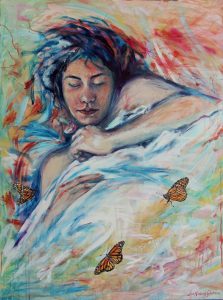
Wow—there are so many! There’s the state of flow when I’m completely engrossed in what I’m doing, and the sheer magic of creating something out of nothing. I love the physical pleasures of making art: mixing and applying colour, feeling the brush in my hand, watching paint move across a surface, seeing lines emerge from a pencil or building texture and colour stitch by stitch through embroidery. All of it is such a delight. There’s also the thrill of falling in love with my own work when things are going well, and the wonderful feeling when someone else connects with something I’ve made and wants to live with it in their home. For me, the rewards are both in the making and in the sharing. The process itself is enormously fulfilling but knowing that something I’ve created has touched someone else is incredibly gratifying.
What have been some career highlights?
Receiving the King Charles III Coronation Medal in 2025 was certainly a significant career highlight and a very special honour. Some of my solo exhibitions have also been particularly meaningful. I had the opportunity to present two exhibitions, Immersed and Nature’s Refuge, at Galerie de la Ville in Dollard-des-Ormeaux. It was a wonderful opportunity to showcase entire bodies of work in a respected professional exhibition space. Another important milestone was Dreamers at the Seagram Gallery in the Centaur Theatre. I had spent several years developing that body of work, so seeing it come together as a cohesive exhibition and sharing it with an audience was particularly gratifying.
How have you evolved as an artist over time?
I started out painting still lifes and portraits, with a strong emphasis on realism. I then moved into painting animals in vivid, unrealistic colours, eventually adding landscapes to my repertoire. My forest paintings, for example, are intended to make viewers feel immersed in a forest rather than depict every leaf and clump of moss. These days, I paint animals more faithfully, although they’re still clearly paintings rather than photographs. I’ve also returned to portraiture, trying to capture the person beneath the physical appearance. Over the past five years or so, I’ve increasingly incorporated textiles into my work through beading, embroidery, quilting, appliqué and collage. I love exploring these possibilities. I also do portrait commissions, which are a great way to hone my skills while making people happy.
How would you describe your style today?
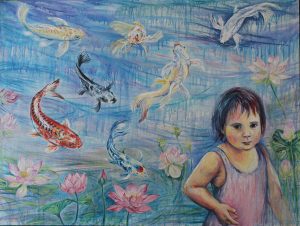
I always struggle with this. I don’t have a very good elevator pitch! I’d describe my style as “contemporary expressive realism”, with a somewhat fanciful and narrative quality. I love luminous colour, visible brushstrokes and rich layers. My work draws inspiration from the natural world and our relationship with it, bringing together figurative imagery, wildlife and imaginative landscapes. There’s often an interplay between representation and abstraction, as I like to leave drips and marks visible rather than refine everything away. I also sometimes incorporate reclaimed textiles, embroidery and found materials. Ultimately, my work is a celebration of nature and the interconnectedness of life. I’m interested in fragility, resilience and belonging, and hope my paintings evoke a sense of wonder, invite curiosity and encourage people to look a little more closely at the world around them.
Is your creative process more “inspirational” or “perspirational”?
I think you’re referring to Thomas Edison’s famous quote: “Genius is one percent inspiration and ninety-nine percent perspiration.” I’d say my creative process is very much a combination of the two, although perhaps with a little more perspiration than I’d like to admit! I always start with something. With a commission, the inspiration is often provided for me; I have a subject and a direction. When painting for myself, I usually sketch or plan ahead, spending a lot of time thinking about a painting before I begin. Sometimes I lie awake at night visualizing things and working out the details. I probably do more sketching mentally than I ever do in my sketchbook! I also use my iPad to photograph works in progress and experiment with changes in Procreate before committing to them on canvas. I’m fairly disciplined about my studio routine and try to get to my art by 10 a.m. on studio days. I also like having several projects underway at once. There’s almost always a textile project on my sewing table, something on my drawing table and two or three paintings that I rotate between. If I get stuck with one piece, I move on to another and come back with fresh eyes. Of course, the process isn’t always easy. Most paintings go through an ugly stage, and you have to trust that you can work your way through it. Working in oils requires particular patience, sometimes waiting weeks for paint to dry before continuing! I believe I grow as an artist by making art—lots of it. I need to keep experimenting, solving problems, taking risks and making mistakes. Inspiration might provide the initial spark, but perspiration is what carries it forward, through all the technical challenges of making an idea work. Ultimately, inspiration gets me started, but perspiration gets the painting finished.
 What makes a good painting?
I think that’s almost impossible to answer unequivocally. Everyone brings their own perspective, tastes and ideas about what makes a painting successful. I’m drawn to compositions that lead the eye around the canvas and invite viewers to spend time exploring the work. I like paintings with layers of meaning, that suggest a story or leave something for the viewer to discover. I appreciate technical skill, but that doesn’t necessarily mean realism or photographic accuracy. It can be expressed through colour, composition, rhythm, pattern, expressive linework or interesting brushwork. Ultimately, I think a successful painting is one that makes you stop, look a little longer and feel something. It doesn’t have to be beautiful or technically perfect, but it should engage you and leave you with something to think about.
What are your thoughts on the current state of the visual arts on the West Island?
There’s always so much happening in the West Island visual arts community, which is why I think this magazine is such a boon. It connects people, keeps everyone informed and brings together information about all the wonderful things happening here. The loss of Galerie de la Ville is, I believe, tragic. Stewart Hall Gallery and the Peter Yeomans Cultural Centre Gallery in Dorval are among the few comparable public exhibition spaces available to West Island artists. Opportunities are relatively infrequent and calls for submissions can be difficult to find. I hope Arts Ouest will help fill that gap and become a go-to resource for local creatives. I’d also love to see something like a West Island version of the Belgo Building or Saint-Ambroise Studio complex: a place where artists could have affordable studios, work alongside one another and build a creative community. Studio spaces are few and far between here, and rents are often prohibitively expensive. We have so many artists groups operating independently of one another, each one with its own ethos and synergy amongst the members: wouldn’t it be awesome to have an arts festival where all the groups gathered in the same space to share their works with the public. I look at how the Vaudreuil-Soulanges region supports its artists through residencies, exhibitions, showcases and public art initiatives, and wish we had something similar on the West Island. Commercial galleries naturally must focus on sales, but not all artists make commercially oriented work. Public galleries, cultural centres and municipal support are essential for providing exhibition opportunities and bringing art into the public realm without everything being driven by commercial considerations. I think the West Island has a wonderful creative community and enormous potential. What we need are more spaces, more visibility and more sustained support for the artists who live and work here.
How has the internet, and specifically AI, affected what you do?
The internet has had a wonderfully positive impact on my work. I now have access to an incredible range of photographic imagery that I can use as reference. Through Instagram, I’ve virtually met talented photographers from around the world who have generously allowed me to use their photographs. I always credit them, and these connections have opened up a whole world of creative possibilities. AI, however, is a different story. I have serious reservations about how it’s being used in the creative world, particularly the growing tendency to replace human artists, illustrators and graphic designers with AI-generated work. I’m also troubled by the unauthorized use of artists’ work to train these systems, often without their knowledge or consent. I believe this raises serious ethical questions and threatens the livelihoods of creative people. For me, making art is about experimenting, taking risks, making mistakes, solving problems and discovering things along the way. Those experiences are essential to developing as an artist. I worry that if we increasingly outsource that process, we risk losing something fundamental about what it means to be creative. Technology can be a wonderful tool, but I believe it should support human creativity, not replace it.
 What’s next on your creative agenda?
I’m really excited about a new collaboration with the über-talented artist Claire Desjardins, who serendipitously happens to be my sister-in-law! We’re exploring family connections, shared histories and the ways our experiences and perspectives can diverge. It’s an exciting challenge because it’s taking my work in new directions. I’m working with groups of people and interior spaces, subjects that push me into somewhat unfamiliar territory. Perhaps most excitingly, I’ve dusted off my oil paints after 38 years and started working with them again! It’s been wonderful to revisit a medium I haven’t used in decades and discover what it might bring to this new body of work. I love challenging myself, stepping outside my comfort zone and allowing a new project to take me somewhere unexpected. I’m really looking forward to seeing where this collaboration leads!
lkglickman.com
@lkglickman.art








